ComplyAIQ Insights
Insights and analysis on AI governance, emerging regulations, and the evolving healthcare compliance profession.
Advancing the healthcare compliance profession for the AI era.

What Should Compliance Professionals Know About Agentic AI?

September 7, 2026, by: ComplyAIQ
There’s a lot of conversation right now about agentic AI. Technology companies are introducing AI agents, healthcare organizations are beginning to explore agentic workflows, and there’s no shortage of predictions about how AI agents are going to transform healthcare.
Healthcare compliance professionals should absolutely be paying attention. But there’s a risk in jumping too quickly to the newest AI topic before having a strong foundation in the basics.
Agentic AI is important, and it will create new and more complex governance questions. But its use in healthcare is still relatively early, and many healthcare organizations are still working through much more basic questions about AI governance.
So, what should compliance professionals actually know about agentic AI right now?
First, What Is Agentic AI?
There isn’t one universally accepted definition of agentic AI, and like a lot of AI terminology, the term is sometimes used pretty loosely. But the basic idea isn’t that complicated.
Most of the generative AI tools we’ve become familiar with primarily produce something. You ask a question or give the AI an instruction, and it generates a response, summary, draft, analysis, recommendation, image, or other output.
Agentic AI goes a step further. Instead of only producing an output, an AI agent can be given an objective and then take steps toward accomplishing it. Depending on the system and the authority it has been given, it might retrieve information, use other software tools, interact with systems, make a series of decisions, initiate workflows, communicate with people, or take other actions with varying levels of human involvement.
Think about a simple example. One AI system drafts an email for an employee, and the employee reviews it and decides whether to send it. Another system identifies who needs to receive the communication, gathers the necessary information, determines what needs to be communicated, drafts the message, and sends it.
Both might use generative AI, but the second system has been given much more authority to act. That’s where the compliance and governance conversation starts to change. Generative AI expanded what AI could produce. Agentic AI expands what AI may be permitted to do.
Is Healthcare Actually Using Agentic AI Yet?
This is an important question because the amount of attention agentic AI is getting can make it seem like autonomous AI agents are already everywhere. They aren’t.
AI adoption broadly is moving quickly in healthcare, and generative AI is increasingly being incorporated into healthcare organizations and technology. Agentic AI is earlier.
Research published in 2026 by Microsoft and The Health Management Academy found that 43% of surveyed healthcare organizations were piloting or testing agentic AI, but only 3% reported having agents deployed in live workflows. McKinsey has similarly found a significant gap between generative AI implementation and agentic AI maturity, while KLAS Research has described agentic AI as still being in its early days based on the healthcare AI use cases it has evaluated.
Academic research tells a similar story. There is growing interest in healthcare AI agents, but much of the research remains focused on exploratory studies, benchmarks, and controlled environments rather than widespread real-world deployment.
The exact numbers are going to vary depending on what someone means by an “AI agent,” what counts as implementation, and who is being surveyed. But the bigger picture seems pretty clear: healthcare is actively exploring agentic AI, and that is different from agentic AI being widely deployed across healthcare today.
That distinction is important for compliance professionals to understand. If your organization is still trying to figure out where AI is being used, who is responsible for governing it, how AI risks should be evaluated, or what basic guardrails should be in place, you’re not necessarily behind. Those are still very real governance questions across healthcare.
At the same time, agentic AI shouldn’t be dismissed as something far off in the future. Organizations are piloting it, vendors are building it into healthcare technology, and these capabilities will continue moving into actual healthcare workflows. Therefore, this is a good time to start understanding it.
Why Does Agentic AI Change the Risk?
Let’s go back to the email example. An employee asks an AI tool to draft a patient communication. The AI generates the draft. The employee reviews it, makes corrections if necessary, and decides whether to send it.
There are obviously still risks. The AI could generate inaccurate information, sensitive information could be handled improperly, or the employee could rely too heavily on the output. But there is still a person between the AI-generated output and the final action of actually sending the email.
Now imagine an AI system that identifies which patients need a communication, accesses information from organizational systems, determines what message should be sent, creates it, and sends it. The governance analysis starts to change.
Now we need to know what the AI is actually authorized to do. What systems can it access? What information can it retrieve? What decisions can it make on its own? When does a human need to approve an action? Can we see what actions the AI took after the fact? What happens when it encounters something outside the normal workflow? Who is ultimately accountable? And how do we stop or limit the system if something starts going wrong?
Those questions aren’t completely foreign to compliance professionals. In fact, a lot of them should sound pretty intuitive.
A Lot of the Governance Principles Aren’t New
Take the principle of least privilege. We generally don’t give people unlimited access to systems and information simply because access might be useful to them. Access should be appropriate for the role and purpose. The same concept becomes important when an AI agent can interact with organizational systems. What does the agent actually need access to, and what should it be allowed to do once it gets there?
The same is true for approval controls and segregation of duties. There are plenty of activities in healthcare where we intentionally require another person, another approval, or another control before something happens. If an AI system is capable of completing multiple steps in a workflow on its own, organizations will need to think carefully about where those checkpoints still belong.
Monitoring is critical too. If an AI tool generates a draft that a person reviews, there is already a natural point of human oversight. If an AI system is independently taking hundreds or thousands of actions, organizations need another way to know whether those actions are appropriate and whether the system is behaving as intended.
Don’t Skip the Fundamentals
This may actually be the most important point of this article: compliance professionals should learn about agentic AI, but they shouldn’t jump straight to agentic AI without first developing a strong foundation in AI and AI governance.
There is always going to be another AI term. We’ve moved through predictive AI, generative AI, copilots, agents, and multi-agent systems, and there will inevitably be something else after that. If we constantly chase the newest term, it’s easy to know a little bit about everything without developing a strong foundation in anything.
For compliance professionals, knowing the fundamentals will be critical because they provide the foundation for the additional complexity that emerging AI technologies will bring. Do you understand, at a practical level, what AI is and how it is being used? Do you understand the major risks AI can introduce into healthcare operations? Do you know where AI is being used in your organization? Does your organization have a process for evaluating the risk of different AI use cases? Who is accountable for AI governance? What guardrails are in place? How are vendors being evaluated? How is AI monitored after implementation?
Those may sound like basic questions, but they are important questions. And adding agentic AI doesn’t make any of them less important. In many cases, it makes them even more important.
An organization that doesn’t know where AI is being used today is going to have an even harder time governing AI that can independently take actions tomorrow. An organization that hasn’t decided who is responsible for evaluating AI risk isn't going to solve that problem by adding more autonomous AI technology.
The same applies to individual compliance professionals. If you are still developing your understanding of AI governance, you do not need to stop everything and become an expert in AI agents. Build the foundation first. Understand AI, understand the risks, and understand the fundamentals of AI governance. Then add agentic AI as another layer of that knowledge.
What Could This Look Like in Healthcare?
There are a lot of potential applications. Agentic systems could participate in workflows involving patient scheduling and communications, revenue cycle operations, administrative processes, compliance monitoring, contracting, credentialing, research, and other healthcare functions.
But simply hearing that something is an “AI agent” doesn't tell us very much about its actual risk. An agent performing a narrow administrative task with limited system access, limited authority, and human oversight is very different from an agent that can access sensitive information, move across multiple systems, make consequential decisions, and take actions without human approval.
For compliance professionals, I think there are four simple questions worth remembering: What can it access? What can it decide? What can it do? And who is overseeing it?
You don’t have to understand every technical component behind an AI agent to start asking those questions. They get us away from the terminology and back to what actually matters from a governance perspective: what authority are we giving this technology, what risk comes with that authority, and what controls are appropriate for that risk?
Compliance Still Needs to Own Its Lane
None of this means Compliance needs to become the AI engineering department, and it certainly doesn’t mean Compliance needs to own every AI agent or the organization's entire AI governance program.
Effective AI governance should be multidisciplinary. IT, information security, privacy, legal, clinical leadership, operational leaders, data teams, and others may all have a role depending on the organization and the use case.
But Compliance has an important lane to own. As AI systems become capable of taking more actions with less direct human involvement, compliance professionals need to be able to recognize where those systems could create or increase compliance risk.
Technical teams may understand how the agent works, and operational teams may understand what they want it to accomplish. Compliance needs to be prepared to ask what could go wrong from a compliance perspective and whether the governance surrounding the system is doing enough to mitigate that risk.
Learn About Agentic AI. But Build the Foundation First.
Agentic AI is real. It is developing quickly, and we will likely see much more of it in healthcare over the next few years. For many healthcare organizations, however, it isn't the most immediate AI governance challenge today.
The immediate challenges may be much more basic: Do we know where AI is being used? Do we have the right people involved in governing it? Are we evaluating AI based on risk? Do we have appropriate guardrails? Are we appropriately evaluating our vendors? Are we monitoring AI after implementation?
Healthcare organizations need to get those fundamentals right while preparing for what comes next. Compliance professionals should do the same.
Learn about agentic AI. Understand why increasing autonomy changes the risk, and pay attention to how these technologies are developing. But don't skip the foundation trying to get to the newest thing.
Strong AI governance fundamentals are what will prepare compliance professionals for agentic AI and whatever comes after it.
About ComplyAIQ
ComplyAIQ is a professional organization dedicated to modernizing the healthcare compliance profession for the AI era. Through professional credentials, thought leadership, and practical resources, ComplyAIQ equips healthcare compliance professionals to become trusted leaders in responsible AI governance.
The AIP-HC™ – Artificial Intelligence Professional in Healthcare Compliance is ComplyAIQ’s flagship professional credential, designed to define and validate competence in navigating AI-related risks and governance within healthcare compliance.
Ready to build your AI governance expertise?

Compliance Professionals Don’t Need to Own AI Governance. They Need to Own Their Lane.

August 30, 2026, by: ComplyAIQ
As healthcare organizations work to build AI governance structures, a basic question is emerging:
Who should own AI governance?
Should it be IT? Information Security? Compliance? Clinical leadership? A dedicated AI governance function?
There may not be one right answer. More importantly, it may not even be the most important question.
A better question might be: Does everyone involved understand their role, and are they prepared to own it?
One of the biggest risks in building effective AI governance is any single group within an organization thinking it can do it alone.
AI simply touches too many areas.
Its use can affect patient care, privacy, cybersecurity, regulatory compliance, billing, employment, contracting, operations, quality, data governance, and much more. No single function has the expertise or perspective to fully understand all of those risks.
That is why a strong foundation for AI governance should be multidisciplinary.
Clinicians understand patient care and clinical workflows. IT and information security bring critical knowledge of technology, infrastructure, access, and security. Operational leaders understand how technology is actually being used in day to day work. Legal brings an important perspective on legal obligations and liability. Privacy professionals understand how information is collected, used, shared, and protected.
And compliance professionals bring an important perspective too.
Compliance has a lane to own
Compliance does not need to own the entire AI governance program.
That should not be an unfamiliar concept for compliance professionals.
Consider billing. Compliance does not own billing. Revenue cycle, coding, clinical operations, finance, and other functions may own the processes that ultimately produce a claim. But compliance still plays an important role in helping the organization identify and mitigate billing compliance risk.
Compliance assesses risk. It helps establish policies and controls. It provides or supports education. It conducts or oversees auditing and monitoring. It investigates concerns. It helps identify corrective action when problems are found.
The fact that Compliance does not own billing does not mean that billing compliance risk belongs to someone else.
AI should be viewed in much the same way.
Compliance does not need to own the technology, develop the models, manage every AI enabled workflow, or make every decision about how AI is used. But when AI creates or changes compliance risk, Compliance has a responsibility to understand that risk and help the organization address it.
That distinction matters.
Compliance professionals do not need to become data scientists or understand every technical detail of how an AI model works.
But they do need to own their lane.
Healthcare compliance programs already have established responsibilities for identifying risk, setting expectations, providing education, monitoring activity, investigating concerns, escalating issues, and promoting accountability.
AI does not make any of those responsibilities go away.
Instead, it changes the environment in which they are carried out.
Compliance professionals should be considering how AI changes the organization’s compliance risk profile. They should consider whether existing policies and controls still work when AI enters a workflow. They should recognize where AI may affect areas already within the scope of the compliance program, whether that involves billing and coding, auditing and monitoring, investigations, regulatory requirements, or other established compliance areas.
Compliance professionals also need to recognize when something falls outside their expertise and make sure the right people are involved.
Owning the lane requires understanding AI
There is an important prerequisite to all of this.
Compliance professionals cannot meaningfully evaluate AI related compliance risk without understanding AI well enough to recognize the risks it creates.
That does not mean learning how to build a large language model.
It means developing enough AI literacy to understand how these technologies are being used, what can go wrong, and where those risks intersect with existing compliance responsibilities.
The same is true for everyone involved in AI governance.
Clinicians do not need to become attorneys or AI engineers. But clinicians involved in governance should understand the unique risks AI can introduce into clinical care.
Operational leaders do not need to become cybersecurity professionals. But they should understand how AI can change the risks within the workflows they oversee.
This is where multidisciplinary AI governance becomes meaningful.
Each discipline brings its existing expertise to the table, along with enough understanding of AI to recognize how AI changes the risks within that area of expertise.
Collaboration still requires accountability
There is another challenge with multidisciplinary governance.
If AI governance belongs to everyone, there is a risk that specific responsibilities end up belonging to no one.
An AI committee alone does not solve that problem.
Organizations still need clarity about who identifies new AI uses. Who evaluates the risks. Who has authority to make decisions. Who monitors what happens after implementation. Who responds when something goes wrong. And who makes sure significant issues reach the right level of leadership.
Those responsibilities are likely to cross traditional organizational boundaries. That is exactly why clearly defined roles matter.
The goal does not have to be finding one department capable of owning everything. The goal should be building a structure where the right people are involved and everyone understands what they are responsible for.
For compliance professionals, that means avoiding two extremes.
Compliance does not need to argue that AI governance belongs to Compliance.
But compliance professionals cannot reasonably conclude that someone else “owns AI,” so compliance risks associated with AI are sufficiently being addressed without Compliance at the table.
Own your lane
AI governance will not look exactly the same in every healthcare organization. Size, structure, technology, resources, existing governance functions, and risk profile all matter.
But the foundation should be consistent.
AI governance requires collaboration among people with different areas of expertise. Those professionals need to understand the unique risks AI introduces generally, but they also need to understand how those risks intersect with their own responsibilities.
For healthcare compliance professionals, that makes AI competence increasingly important.
Compliance does not have to own AI governance.
But compliance professionals should be prepared to own their lane within it.
That means understanding AI well enough to bring their existing compliance expertise to the table, and getting to that table early enough for that expertise to matter.
Compliance functions that wait to get involved in AI governance discussions until the risks are already baked in will be much less effective at helping their organizations address them.
It’s time for the compliance profession to get involved early, bring its expertise to the table, and own its lane.
About ComplyAIQ
ComplyAIQ is a professional organization dedicated to modernizing the healthcare compliance profession for the AI era. Through professional credentials, thought leadership, and practical resources, ComplyAIQ equips healthcare compliance professionals to become trusted leaders in responsible AI governance.
The AIP-HC™ – Artificial Intelligence Professional in Healthcare Compliance is ComplyAIQ’s flagship professional credential, designed to define and validate competence in navigating AI-related risks and governance within healthcare compliance.
Ready to build your AI governance expertise?

You Can't Manage AI Risk You Can't See
You Can't Manage AI Risk You Can't See

August 15, 2026, by: ComplyAIQ
There is no shortage of discussion about how healthcare organizations should govern artificial intelligence. Risk assessments, policies, oversight committees, monitoring, human review, and so on.
But before getting to any of those issues, there is a more basic question:
Do you actually know where AI is being used in your organization?
The U.S. Department of Health and Human Services has made that question part of its own approach to AI governance. HHS maintains a public inventory (see here) of current and planned AI use cases as part of its internal AI-governance approach. Led through an annual process by HHS's Chief Artificial Intelligence Officer, the inventory is intended to support transparency, accountability, and secure AI use.
This is an internal U.S. federal-government practice, not a requirement imposed on healthcare providers or other private healthcare organizations. Still, HHS's approach is worth paying attention to. HHS considers an up-to-date understanding of where AI is being used important enough to make it part of its own governance structure.
The logic is fairly simple: you can't effectively manage AI risk you can't see.
For healthcare compliance professionals, that makes the AI inventory much more than a list of technology. It can be the starting point for connecting AI use to things compliance programs already do, such as identify risk, assess it, establish accountability, monitor it, document it, and escalate concerns when necessary.
Finding the AI Is Harder Than It Seems
An AI inventory seems simple enough. Find the AI systems the organization uses and make a list.
However, the task is more complicated in reality.
Some AI tools are easy to identify. An organization may deliberately purchase an AI documentation tool, diagnostic application, or generative AI platform. Those implementations will probably pass through some combination of procurement, IT, information security, privacy, legal, and/or operational review.
However, AI increasingly arrives in less obvious ways.
A vendor may add an AI feature to software the organization has used for years. An existing platform may introduce predictive capabilities or a generative AI assistant through a product update. Employees may begin using publicly available generative AI tools without going through a traditional procurement process. A third-party service provider may use AI in delivering services even though the healthcare organization is not directly operating the AI system.
Even the terminology can get in the way. A product may use machine learning or predictive models without users thinking of it as “AI” at all. And an AI-enabled feature inside an existing product may present a different governance question than a stand-alone AI system or a particular AI use case.
Federal health IT policy provides a useful example. Under the HTI-1 final rule, the Office of the National Coordinator for Health Information Technology (ONC) established algorithm-transparency requirements for certain predictive algorithms, including AI, that are supplied by certified health IT developers as part of certified health IT such as electronic health record systems and modules that meet applicable requirements under ONC's Health IT Certification Program.
The requirements are intended to give clinical users a consistent baseline of information about these algorithms, including their purpose and intended use, development, validation and performance, and relevant risk-management practices. The objective is to help users assess whether an algorithm is fair, appropriate, valid, effective, and safe for its intended use.
Importantly, these requirements operate through ONC's Health IT Certification Program, and they reach only certain algorithms within certified systems—not every AI tool a provider organization may be using, including many tools vendors add on top of certified systems or that staff adopt independently. They do not create a general AI-inventory mandate for healthcare provider organizations. Still, ONC has noted that certified health IT supports care delivered by more than 96 percent of U.S. hospitals, which illustrates how consequential algorithmic capabilities can be embedded in technology healthcare organizations already use, and why an AI-discovery process cannot depend solely on looking for products labeled "AI," or assume that a framework like this one is already doing that discovery work.
So the challenge isn't just identifying products with “AI” in their names. Organizations need some way of recognizing AI-enabled functions and use cases that may matter from a governance and compliance perspective.
An Inventory Should Tell You More Than What You Own
NIST’s voluntary AI Risk Management Framework includes an outcome within its GOVERN function calling for mechanisms to inventory AI systems, with those mechanisms resourced according to organizational risk priorities. Its accompanying Playbook provides suggested actions for putting that outcome into practice.
That's useful because it moves the conversation beyond simply making a list.
A spreadsheet with the name of an AI product, the vendor, and the department using it may be an inventory in the most literal sense. But it doesn't necessarily tell the organization what it needs to know to manage risk.
What does the system actually do? Where is it being used? Who is responsible for it? What information does it process? Who may be affected by its outputs? Is it influencing patient care, billing, employment, compliance, or another significant decision? Is a vendor involved? Has the organization assessed the use for risk? What oversight applies?
Not every organization needs the same inventory structure, and there is no universal federal rule prescribing a particular set of inventory fields that every healthcare organization must maintain.
The more important question is whether the inventory gives the organization enough information to connect an AI use to the appropriate governance and risk-management processes.
For compliance, that connection is important.
If a significant AI use isn't known, it may never make its way into a compliance risk assessment. If a new vendor capability isn't identified, questions about privacy, contractual obligations, or appropriate use may never be asked. If no one knows who owns an AI use, accountability becomes much harder when concerns arise.
The value of the inventory is not the list itself. It is what the organization can do because the list exists.
The Inventory Can't Be a One-Time Project
Even a good inventory can become outdated quickly.
AI systems change. Vendors release new features. Models are updated. Employees find new uses for existing tools. A pilot expands into normal operations. A tool approved for one purpose begins being used for another.
This is one reason HHS’s annual AI-use-case inventory process is notable. It provides an example of a recurring process designed to capture current and planned AI uses, rather than treating inventory as a one-time exercise.
The same lifecycle issue appears elsewhere in federal AI oversight. FDA’s final guidance, Marketing Submission Recommendations for a Predetermined Change Control Plan for Artificial Intelligence-Enabled Device Software Functions, addresses information that device manufacturers may include in a marketing submission for a Predetermined Change Control Plan, or PCCP. A PCCP may describe specified planned modifications to an AI-enabled device software function, the methodology to develop, validate, and implement those modifications, and an assessment of the modifications’ impacts. When FDA authorizes a PCCP, the manufacturer may implement modifications described in that PCCP without submitting a new marketing submission for each individual modification.
That guidance does not apply to every AI tool used by a healthcare organization, and it is not an AI-inventory requirement for hospitals or health systems. But it illustrates the broader lifecycle reality: AI-enabled technology may change materially after implementation.
That is particularly important with vendor technology.
An organization may carefully evaluate a product when it is purchased, only for the vendor to introduce new AI functionality months later. The contract may be the same. The product name may be the same. But what the technology is doing, and the risks that need to be considered, may have changed.
An AI inventory therefore has to connect in some way to change management. The organization needs a mechanism for new AI uses, and meaningful changes to existing ones, to make their way back into the governance process.
An inventory that is accurate only on the day it is created is not much of a governance control.
Someone Has to Own the Process, but No One Can Do It Alone
One of the harder questions is who is responsible for finding all of this AI.
The answer probably isn't one department.
IT may know what technology is deployed but not every way employees are using it. Procurement may know what was purchased but not every feature a vendor later adds. Privacy may have visibility into systems involving protected health information but less visibility into tools that never trigger a privacy review. Clinical leaders may understand AI being used in patient care but know little about AI in revenue cycle, HR, compliance, or other administrative functions.
Compliance won't see everything either.
AI discovery therefore has to be multidisciplinary. Procurement, IT, information security, privacy, clinical informatics, legal, compliance, vendor management, operational leaders, and others may all have pieces of the picture.
The important part is having a process that brings those pieces together.
The Joint Commission’s voluntary Responsible Use of AI in Healthcare certification reflects this broader move toward organization-level governance. Its standards address governance, effective data management, risk and bias reduction, monitoring, evaluation and validation of AI safety and performance, and transparency, education, and training. The certification evaluates organizational practices rather than certifying individual AI products.
The relevance to an AI inventory is practical. Organization-wide governance and ongoing monitoring become difficult if the organization doesn't have a reliable way of knowing which AI systems, features, and uses fall within the governance process in the first place.
Where Compliance Professionals Fit
None of this means compliance needs to own the AI inventory (you’re welcome, compliance professionals!).
However, compliance professionals do have something important to contribute.
Much of compliance work already involves finding risk across a large organization, determining which risks deserve closer attention, documenting controls, monitoring activity, evaluating third parties, following up on concerns, and escalating issues when necessary.
AI changes the subject matter, but many of those underlying disciplines are familiar.
The Department of Justice’s Evaluation of Corporate Compliance Programs makes the connection particularly relevant. Its September 2024 revisions ask prosecutors to consider how a company assesses risks associated with new technologies, including AI; how it addresses negative or unintended consequences; and how it mitigates deliberate or reckless misuse. Where a company uses AI or similar technology in its business or as part of its compliance program, DOJ also asks whether controls exist to monitor and ensure its trustworthiness, reliability, and use in compliance with applicable law and the company’s code of conduct.
DOJ does not say companies must maintain an “AI inventory.” But there is an obvious practical problem: an organization cannot meaningfully assess the compliance risks created by AI uses it does not know exist.
This is where compliance professionals can add value without becoming AI engineers or claiming ownership of every aspect of AI governance.
They can ask whether important AI uses are being identified. Whether those uses are reaching the right risk-assessment processes. Whether ownership is clear. Whether vendor changes are being considered. Whether higher-risk uses receive appropriate review. And whether concerns discovered through monitoring, auditing, investigations, or other compliance activities make their way back into the governance process.
Those aren't entirely new compliance skills. They are familiar skills being applied to a new and rapidly changing area of risk.
Start With Visibility
Healthcare organizations are developing increasingly sophisticated approaches to AI governance. Policies, committees, risk classifications, approval processes, and monitoring programs all have a role.
But all of them have the same limitation: they can only govern the AI that enters their field of view.
HHS's own AI inventory is a useful example. NIST includes inventory mechanisms in its voluntary AI Risk Management Framework. And healthcare-specific governance efforts increasingly emphasize organization-wide oversight and monitoring throughout the AI lifecycle.
None of this creates a universal federal requirement for healthcare organizations to maintain a particular AI inventory.
It does point to something more basic.
Before an organization can decide how an AI system should be assessed, monitored, or governed, it has to know the system exists and understand how it is being used.
For healthcare compliance professionals thinking about where to begin with AI governance, that may be one of the most practical questions to ask:
Do we actually know where we're using AI?
About ComplyAIQ
ComplyAIQ is a professional organization dedicated to modernizing the healthcare compliance profession for the AI era. Through professional credentials, thought leadership, and practical resources, ComplyAIQ equips healthcare compliance professionals to become trusted leaders in responsible AI governance.
The AIP-HC™ – Artificial Intelligence Professional in Healthcare Compliance is ComplyAIQ’s flagship professional credential, designed to define and validate competence in navigating AI-related risks and governance within healthcare compliance.
Ready to build your AI governance expertise?
AI and the DOJ’s Signal to Compliance Programs
AI and the DOJ’s Signal to Compliance Programs
August 8, 2026, by: ComplyAIQ
Artificial intelligence is increasingly becoming part of the compliance professional’s responsibility.
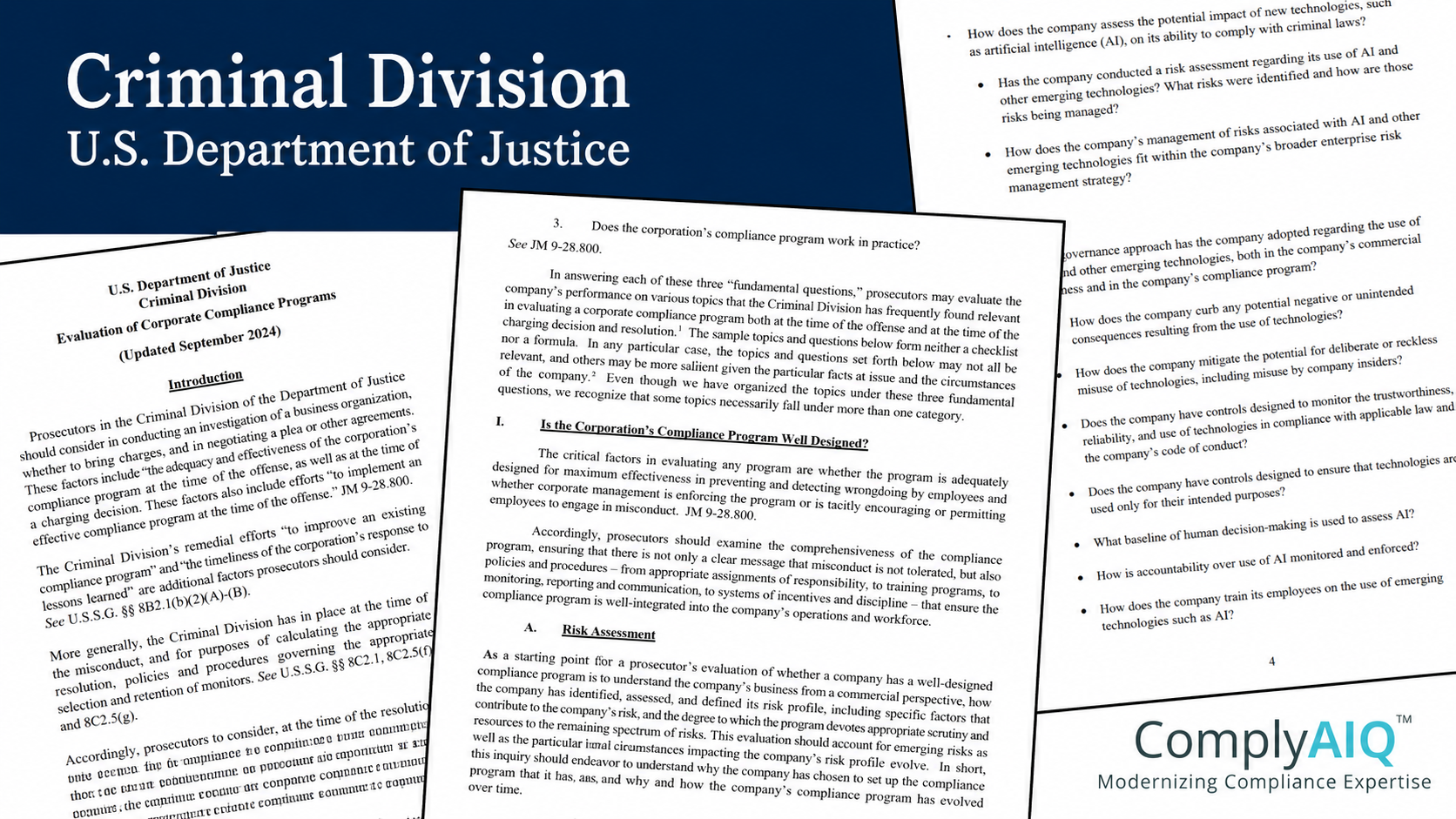
One of the clearest indications came in September 2024, when the U.S. Department of Justice Criminal Division updated its Evaluation of Corporate Compliance Programs (ECCP) to expressly address artificial intelligence and other emerging technologies.
The ECCP is designed to assist federal prosecutors in evaluating the effectiveness of corporate compliance programs when making charging and resolution decisions. Importantly, the DOJ emphasizes that its questions are neither a checklist nor a rigid formula. Compliance programs are evaluated in the context of an organization’s particular size, industry, regulatory environment, risk profile, and other circumstances.
Within that framework, however, the DOJ now expressly directs attention to how organizations identify and manage risks associated with AI and other emerging technologies.
For healthcare compliance professionals, the questions provide a useful framework for considering how AI oversight fits within an effective compliance program.
What the DOJ Is Asking About AI
The DOJ addresses AI within the risk assessment portion of the ECCP, beginning with a broader question about emerging risks:
“Does the company have a process for identifying and managing emerging internal and external risks” that could affect compliance with applicable law?
From there, the DOJ expressly turns to artificial intelligence:
“How does the company assess the potential impact of new technologies, such as artificial intelligence (AI), on its ability to comply with criminal laws?”
The ECCP then asks a series of questions addressing how AI is governed and managed within an organization. Among them:
Is management of AI and other emerging-technology risks integrated into the organization’s broader enterprise risk management strategy?
What governance approach has the organization established for AI used within the business and within the compliance program?
How does the organization address unintended consequences and the potential for deliberate or reckless misuse of technology?
Are controls in place to monitor AI for “trustworthiness, reliability, and use in compliance with applicable law and the company’s code of conduct”?
Are controls in place to ensure that technology is used only for its intended purposes?
“What baseline of human decision-making is used to assess AI?”
“How is accountability over use of AI monitored and enforced?”
“How does the company train its employees on the use of emerging technologies such as AI?”
Taken together, these questions provide a meaningful picture of how the DOJ is approaching AI within the broader evaluation of compliance program effectiveness.
They also map closely to functions that are already familiar to healthcare compliance professionals: risk assessment, governance, policies and controls, education, monitoring, accountability, and corrective action.
AI Within the Compliance Risk Assessment
Risk assessment has long been foundational to the DOJ’s evaluation of compliance program effectiveness. The ECCP describes the starting point as understanding how an organization has identified and assessed its risk profile and whether the compliance program devotes appropriate scrutiny and resources to those risks.
The 2024 update makes clear that AI and emerging technology should be part of that analysis where relevant.
For healthcare organizations, this means understanding where AI is being used and the risks associated with those uses. AI may now appear across clinical decision support, documentation, billing and claims processes, privacy and security functions, research, workforce management, compliance operations, and numerous administrative functions.
The analysis should also be risk-based. An AI application performing a limited administrative function does not necessarily warrant the same level of oversight as an AI system influencing clinical, financial, or other consequential decisions.
The objective is not uniform oversight of every AI application. It is oversight proportionate to the particular technology, use case, and organizational risk.
Governance and Accountability
The DOJ specifically asks about an organization’s governance approach to AI and how accountability over AI use is monitored and enforced.
These questions are particularly significant because effective AI governance extends beyond identifying individual risks. Organizations need to determine who has authority and responsibility for making decisions about those risks.
Depending on the organization and use case, governance may involve compliance, legal, privacy, information security, information technology, clinical leadership, internal audit, risk management, and/or operational stakeholders.
Compliance does not necessarily need to own every aspect of AI governance. It should, however, have a defined role where AI intersects with regulatory and compliance risk.
Organizations should be able to answer practical questions such as:
Who evaluates AI-related compliance risks? Who approves higher-risk uses? What issues require escalation? Who can suspend or restrict an AI system when significant concerns arise? How are important decisions documented? Who is accountable when established requirements are not followed? Are staff sufficiently trained and educated on AI use and risk? Who is responsible for monitoring AI systems? Does the organization have a current inventory of all AI tools in use? Are policies regarding AI use clear and communicated to staff?
These are governance questions that fit naturally within the broader compliance framework.
Controls, Intended Use, and Human Oversight
The DOJ questions move beyond governance structures to the controls surrounding AI itself.
The ECCP asks whether controls exist to monitor the trustworthiness and reliability of AI, whether the technology is being used consistently with applicable law and the organization’s code of conduct, and whether controls ensure that technology is used only for its intended purposes.
The DOJ also specifically asks about the baseline of human decision-making used to assess AI.
For healthcare organizations, these considerations can be incorporated throughout the lifecycle of an AI system.
Before implementation, organizations can define approved uses, identify prohibited or restricted uses, assess relevant compliance and regulatory risks, and establish appropriate human oversight.
After implementation, those expectations can be reinforced through policies, access controls, monitoring, training, escalation mechanisms, and periodic reassessment.
Human oversight becomes particularly important where AI outputs influence consequential decisions, especially patient care. The appropriate form of oversight will vary by use case, but AI should support rather than silently displace professional accountability where meaningful human judgment remains necessary.
Monitoring AI in Practice
The ECCP also asks how organizations address potential negative or unintended consequences associated with technology and mitigate deliberate or reckless misuse.
Those questions point toward an important principle: AI governance does not end when a system is approved.
AI systems and their uses can change over time. Performance may shift. Organizational workflows may evolve. Vendors may modify products or introduce new capabilities. Employees may also begin using approved technologies in ways that were not originally contemplated.
Healthcare compliance programs can address these risks by extending established auditing and monitoring practices to AI.
Depending on the system and its risk profile, this might include monitoring adherence to approved-use requirements, evaluating vendor performance, reviewing incidents and unexpected behavior, assessing bias or performance drift where relevant, and periodically reassessing whether existing controls remain appropriate.
The technology is different, but the compliance discipline is familiar: identify the relevant risk, establish controls, monitor their effectiveness, and respond when weaknesses are identified.
Training, Communication, and Accountability
One of the DOJ’s most direct AI-related questions is:
“How does the company train its employees on the use of emerging technologies such as AI?”
That question has immediate relevance for healthcare organizations.
Employees using AI tools may need guidance regarding acceptable use, privacy and confidentiality, human review, organizational policies, and escalation of concerns.
Managers and operational leaders may require additional education regarding their oversight responsibilities. Compliance, privacy, legal, audit, and other governance professionals may require deeper knowledge to effectively evaluate AI-related risks and controls.
Training should therefore be tailored to role and risk rather than treated as a single, uniform educational requirement.
Education should also connect employees to established mechanisms for seeking guidance and reporting concerns. When inappropriate AI use or other problems are identified, organizations should be prepared to investigate, address the issue, apply accountability where appropriate, and use lessons learned to strengthen the governance process.
Integration, Not Addition
Perhaps the most useful takeaway from the DOJ’s treatment of AI is where these questions appear.
The DOJ did not create a separate evaluation framework for an “AI compliance program.” It incorporated AI and emerging technology into its broader framework for evaluating corporate compliance programs.
Healthcare organizations already have much of the architecture needed to begin addressing AI-related compliance risks.
Existing risk assessments can incorporate AI.
Codes of conduct and policies can establish expectations for appropriate AI use.
Governance structures can define responsibility and accountability for AI-related decisions.
Training programs can incorporate AI-related responsibilities.
Reporting and escalation mechanisms can receive AI-related concerns.
Auditing and monitoring functions can assess AI systems, uses, and controls.
Established investigation and corrective-action processes can respond when AI-related issues occur.
The emergence of AI does not make these established compliance functions obsolete. It expands the environment in which they must operate.
For healthcare compliance professionals, the DOJ’s 2024 ECCP update therefore provides more than a list of questions about a new technology. It illustrates how emerging AI risks can be addressed through the core disciplines of an effective compliance program.
As artificial intelligence becomes increasingly integrated into healthcare operations, the opportunity is to evolve those established compliance practices alongside it—supporting innovation while maintaining appropriate governance, accountability, and oversight.
The Takeaway
The DOJ’s inclusion of AI questions in the 2024 ECCP sends a clear signal to compliance professionals: as AI becomes more integrated into organizational operations, the organization’s compliance program should be utilized to address associated risks.
For healthcare compliance leaders, this does not require building an entirely new compliance framework. It means applying established compliance disciplines—risk assessments, governance, policies, training, monitoring, accountability, and corrective action—to the evolving use of AI.
The opportunity for compliance professionals is to help their organizations adopt AI responsibly and to evolve the compliance program alongside the evolution of technology.
About ComplyAIQ
ComplyAIQ is a professional organization dedicated to modernizing the healthcare compliance profession for the AI era. Through professional credentials, thought leadership, and practical resources, ComplyAIQ equips healthcare compliance professionals to become trusted leaders in responsible AI governance.
The AIP-HC™ – Artificial Intelligence Professional in Healthcare Compliance is ComplyAIQ’s flagship professional credential, designed to define and validate competence in navigating AI-related risks and governance within healthcare compliance.
Ready to build your AI governance expertise?