October 25, 2026, by: ComplyAIQ
Why Healthcare AI Governance Matters With or Without Regulation
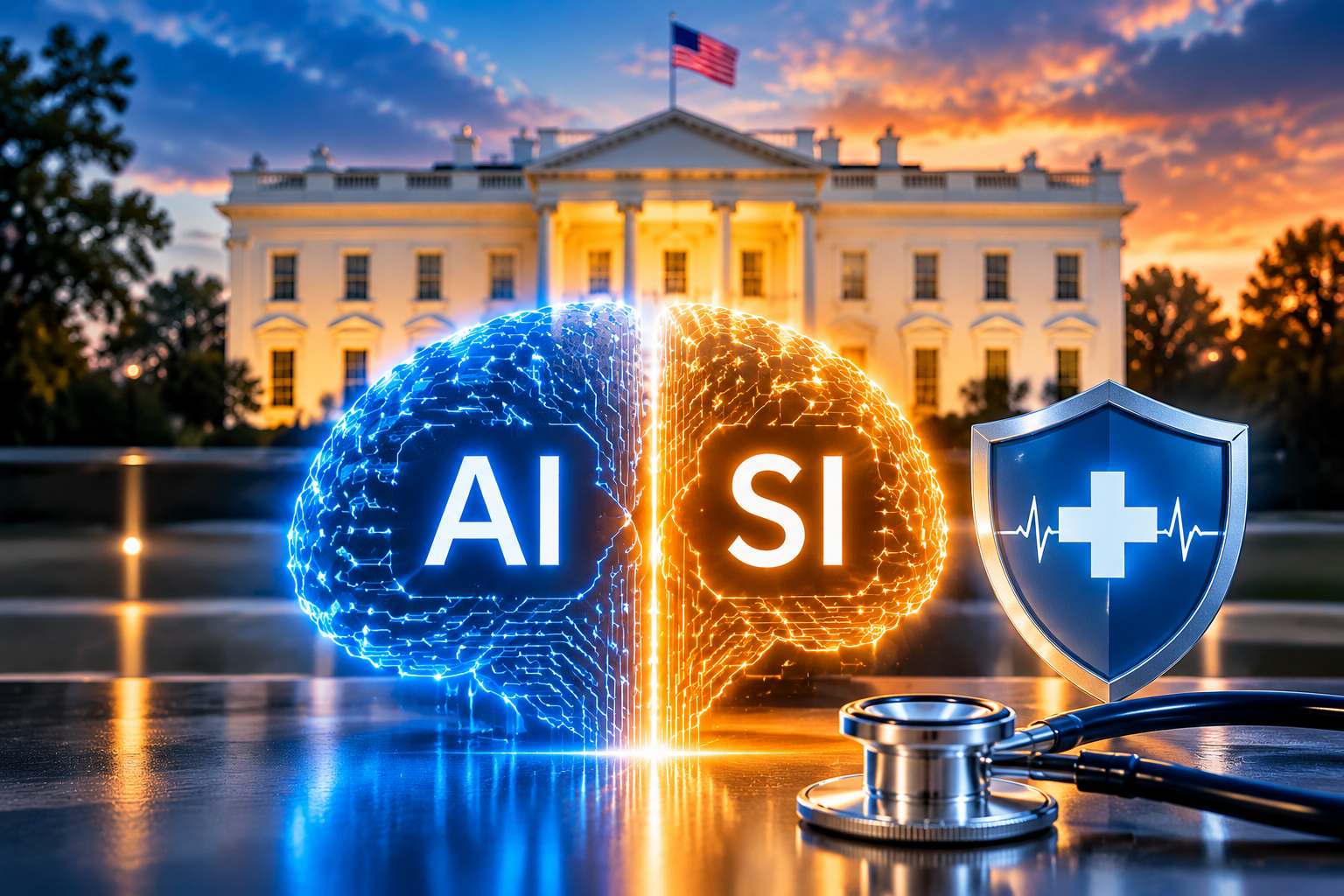
On September 29, 2026, President Donald Trump and leaders of six major technology companies—Google, Anthropic, Meta, OpenAI, xAI, and Nvidia—signed the White House Accord on Super Intelligence: Joint Commitment on Frontier Responsibilities. The brief agreement sets out voluntary commitments for governing frontier AI models.
The same day, the President signed Executive Order 14434, directing executive departments and agencies, to the maximum extent permitted by law, to use "Super Intelligence" (SI) in place of "Artificial Intelligence" (AI) in official correspondence, public communications, websites, reports, policy documents, and other non-statutory documents within the executive branch.
For healthcare compliance professionals, however, the Accord itself may be the more significant development. It calls for internal controls, a dedicated internal team, independent external evaluation, and board-level oversight—concepts familiar to the compliance profession. The signatories also state that they consider these controls critical whether or not they are legally required.
That raises a question worth considering for healthcare: If the companies developing advanced AI recognize the need for governance beyond regulatory mandates, what does that mean for healthcare organizations putting their technology to use?
The Accord does not establish requirements for healthcare organizations using AI, but its governance principles offer a useful point of comparison for organizations deploying these technologies.
What the AI Giants Agreed To
The Accord's commitments are concise but substantive. It describes four layers of controls and audits that companies training and deploying frontier models should implement:
Internal controls to monitor the capabilities and alignment of models during training and deployment in areas such as cybersecurity, biosecurity, and chemical threats, and to ensure models do not hack or access technical systems in unintended ways.
An internal team empowered to ensure the controls, monitoring, and detection operate as intended and that identified issues are remediated.
An independent external auditor or evaluator to assess whether the controls, monitoring, and detection operate as intended.
An independent committee of the board of directors to oversee these activities, receive reports from internal and external reviewers, and ensure identified issues are remediated.
Seasoned compliance professionals should immediately recognize the parallels to established compliance program practices.
However, the Accord has clear limitations. It is voluntary, specifies no penalties for failing to fulfill its commitments, and does not establish detailed criteria for evaluating each company's performance. The participating companies commit to meeting regularly to establish standards and best practices, and the agreement acknowledges that codifying these measures into laws or regulations may make sense over time. Whether the commitments produce effective oversight will depend on implementation.
Nevertheless, the agreement reflects an important acknowledgment by the White House and organizations at the forefront of AI development: technological sophistication and effective governance must go hand in hand.
A Changing Federal Approach
The Accord arrives amid a broader shift in federal AI policy. The Trump administration has emphasized American leadership in AI, technological innovation, and avoiding regulatory barriers it believes could impede progress. Supporters of a more flexible approach argue that rapidly evolving technologies benefit from adaptable, industry-led governance. However, critics question whether voluntary commitments provide sufficient transparency, independence, and accountability.
The administration's shift toward “Super Intelligence” terminology also has implications worth considering for compliance professionals. Executive Order 14434 does not require alteration of previously issued contracts, grants, or regulations. For purposes of the order, SI encompasses the technologies covered by the existing statutory definition of artificial intelligence at 15 U.S.C. § 9401(3). The order also directs development of proposed legislation establishing a federal definition of SI.
For compliance professionals, these distinctions are important to understand. A change in terminology does not itself change an organization's obligations, and shifts in federal AI policy should not be confused with changes to the healthcare laws that already apply when AI is used.
Meanwhile, healthcare organizations are making decisions about AI applications today, often without regulatory instructions addressing their particular circumstances. That is where the distinction between regulatory compliance and responsible organizational governance becomes important.
Developer Governance Does Not Replace Organizational Governance
The Accord focuses on companies developing and deploying frontier AI models. Its commitments concern the capabilities, behavior, and risks of the technologies those companies create.
Notably, the Accord presents its controls as giving "each company, its customers, and the public confidence" that the technology is operating as intended. Healthcare organizations are among those customers. That confidence is valuable, but it does not establish that an AI application is appropriate for a particular healthcare environment.
Consider a hospital using an AI-enabled application to assist with clinical documentation. The underlying model may have undergone extensive technical testing, and its developer may maintain internal controls, commission independent evaluations, and report to its board on model safety. Those practices are valuable.
But they do not establish whether the application produces accurate, clinically appropriate documentation within the hospital's workflows. They do not determine whether clinicians use it appropriately, whether outputs receive the intended review, or whether documentation errors could affect coding and claims. Those questions arise from the organization's use of the technology, not simply from its development. The same is true of AI supporting clinical decision-making, revenue cycle operations, and patient communications.
Developer assurance and organizational assurance are related, but they are not interchangeable.
The Accord begins with the principle that every company is responsible for developing its own technology safely. For healthcare organizations, the corresponding responsibility is to make informed decisions about how that technology is deployed and used. Strong developer governance can support those decisions. It cannot replace organizational judgment about a particular application's suitability, its risks, or the oversight appropriate to its intended use.
When Less Regulation Does Not Mean Less Responsibility
The current federal policy direction also affects the information healthcare organizations have available when evaluating AI technologies.
In December 2025, the Assistant Secretary for Technology Policy/Office of the National Coordinator for Health Information Technology (ASTP/ONC) proposed the HTI-5 rule, Deregulatory Actions to Unleash Prosperity. Among its proposed changes is the removal of certain transparency and risk-management requirements associated with AI-enabled decision support technologies.
Under the existing HTI-1 framework, certain certified health IT products must support information about predictive decision support tools, including their intended uses, relevant patient populations, and aspects of their development and performance. These requirements do not apply to every healthcare AI application, but they provide an example of how federal certification standards can support organizational evaluation of AI technologies.
The HTI-5 proposal would remove these requirements from the applicable certification framework. The discussion here concerns proposed changes, not finalized requirements.
There may be legitimate reasons to reconsider these requirements. In the proposed rule, ASTP/ONC stated that it had found no publicly available evidence that the transparency requirements produced positive impacts on patient care. Mandated disclosures do not necessarily improve decision-making if the information is difficult to interpret, poorly suited to organizational needs, or rarely used. Regulatory requirements should produce meaningful benefits, not simply additional documentation.
However, removing a disclosure requirement does not eliminate the underlying need for information. If the proposed changes are finalized, healthcare organizations may have fewer standardized sources of information available through the federal certification framework. They may need to rely more heavily on vendor disclosures, contractual arrangements, independent evaluations, or assessments conducted within their own environments.
Importantly, healthcare organizations remain subject to existing legal and regulatory requirements, regardless of changes in federal AI policy. For example, hospitals must continue to meet applicable Medicare Conditions of Participation, including requirements related to quality assessment and performance improvement. Similarly, healthcare providers remain subject to applicable billing and reimbursement laws. The introduction of AI into organizational operations can affect how these existing requirements are met and whether compliance is maintained.
Reducing regulatory requirements imposed on technology developers does not necessarily reduce the responsibilities of healthcare organizations using their products. In some circumstances, it may make those responsibilities more challenging to fulfill.
What This Means for Healthcare Organizations
An AI application may not be prohibited by any AI-specific regulation. That does not mean an organization has adequately evaluated its intended use. Equally, the absence of detailed regulatory guidance should not automatically prevent an organization from adopting a potentially beneficial technology. Responsible governance provides a process for making those decisions.
Those decisions require clinical, technical, operational, legal, and compliance perspectives. Compliance professionals should not be expected to independently determine whether an AI application is clinically or technically suitable; those judgments belong with professionals who have the relevant expertise. Compliance's contribution is helping the organization recognize applicable requirements, consider risks, establish accountability, and ensure important questions reach the right people.
In practice, that work often includes:
Contracting for disclosure. Build expectations for intended use, known limitations, performance characteristics, and notice of changes to the underlying technology into vendor due diligence and agreements, particularly if federal disclosure requirements are removed.
Evaluating locally. Treat developer information as a starting point, with additional evaluation in the organization's own environment where the application's purpose and risk warrant it.
Using existing audit programs. Consider AI-assisted documentation in coding and billing audit samples, and track relevant AI-related events through applicable quality assessment and performance improvement processes.
Assigning accountability. Establish appropriate organizational accountability for AI governance, including committee or board-level reporting where warranted by the risks involved.
The objective is not a uniform set of barriers for every AI application. It is informed adoption, with oversight proportionate to the circumstances.
A Role for the Healthcare Compliance Profession
The Accord's signatories have committed to meeting regularly to develop standards and best practices concerning the safety of their systems. That work may produce valuable guidance for developing and evaluating frontier AI models.
But standards developed primarily from the perspective of technology developers may not fully address what healthcare organizations encounter in deployment: clinical appropriateness, documentation integrity, reimbursement accuracy, patient privacy, operational reliability, and the consequences of AI-supported decisions. Healthcare compliance professionals can contribute that perspective through professional associations, standards development activities, institutional governance, and direct engagement with vendors.
The objective is not to impose healthcare-specific expectations on every AI developer. It is to ensure that discussions about responsible AI reflect how these technologies are used in consequential settings, not only how they are developed. The healthcare compliance profession has considerable experience translating complex requirements into practical oversight, and that experience deserves a place in the conversation.
With or Without Regulation
The Accord's signatories state that implementing controls and audits is critical regardless of whether the government requires them. Healthcare compliance has long operated on a similar principle: effective compliance and ethical oversight involve more than satisfying the minimum legal requirements.
Federal AI policy will continue to evolve, industry standards will develop, and the terminology itself may change. Healthcare organizations will need to continually assess whether AI applications are appropriate for their intended uses, whether relevant risks have been considered, and what oversight is reasonable.
The Accord establishes what leading AI developers have committed to do, but it does not answer every question healthcare organizations must confront when putting those technologies to use.
Whether the technology is called Artificial Intelligence or Super Intelligence, responsible and ethical governance is essential.
References
White House Accord on Super Intelligence: Joint Commitment on Frontier Responsibilities. The White House, September 29, 2026.
Executive Order 14434, Inaugurating the Era of Super Intelligence. September 29, 2026. 91 Fed. Reg. 63129 (October 2, 2026).
15 U.S.C. § 9401(3), definition of artificial intelligence.
ASTP/ONC. Health Data, Technology, and Interoperability: ASTP/ONC Deregulatory Actions to Unleash Prosperity (HTI-5), proposed rule. 90 Fed. Reg. 60970 (December 29, 2025).
42 C.F.R. § 482.21, Condition of Participation: Quality Assessment and Performance Improvement Program.
31 U.S.C. § 3729, False Claims Act.
HHS Office of Inspector General. General Compliance Program Guidance. November 2023.
About ComplyAIQ
ComplyAIQ is a professional organization dedicated to modernizing the healthcare compliance profession for the AI era. Through professional credentials, thought leadership, and practical resources, ComplyAIQ equips healthcare compliance professionals to become trusted leaders in responsible AI governance.
The AIP-HC™ – Artificial Intelligence Professional in Healthcare Compliance is ComplyAIQ’s flagship professional credential, designed to define and validate competence in navigating AI-related risks and governance within healthcare compliance.
Ready to build your AI governance expertise?